The first robot vacuum from the world's leading drone manufacturer, DJI, has arrived. The Rovo P is not just a vacuum; it's a ground-based drone project. It leverages DJI's core technologies—battery management, motor control, and sensor fusion—to navigate your home. But does this 1.6 million KRW (~$1,200) flagship truly outperform the competition, or is it just a pretty piece of hardware? This review breaks down its design, navigation, cleaning performance, and value.

🚀 Design & Build: A Transparent Statement
The most striking feature of the Rovo P is its transparent design. The top of the robot and the front of the docking station are made of clear polycarbonate, revealing the complex internal mechanics. This is a bold aesthetic choice, giving it a sci-fi, high-end PC case vibe. At night, with the lights off, it looks like a reconnaissance robot from a sci-fi film.
📏 Dimensions & Hardware
- Diameter: 35.1 cm
- Height: 9.8 cm
- Design: All sensors are embedded; no protruding LiDAR tower. This makes it taller than some slim models, potentially limiting access to low-clearance furniture.
- Docking Station: A 45cm cube with a clear view of the 4L clean water tank, 3.2L dirty water tank, and 2.4L dust bag. Build quality is excellent, typical of DJI.
Concern: The transparent casing may show dust, hair, and discoloration over time, which could be a hygiene concern for some users.
🧠 The Core Strength: Drone-Grade Obstacle Avoidance
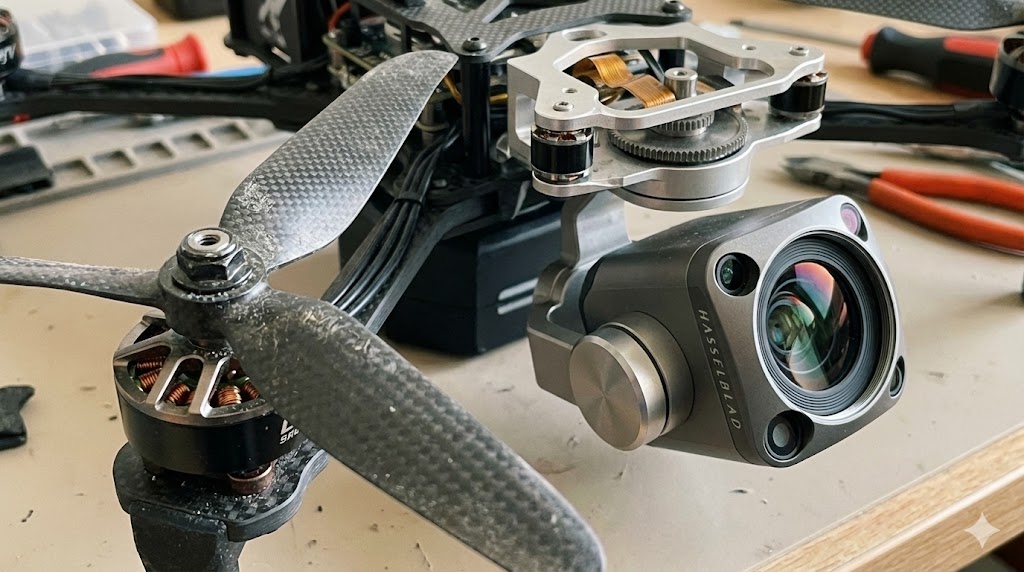
This is where the Rovo P truly shines. Unlike standard robot vacuums that use a single LiDAR sensor and a basic front camera, the Rovo P employs a dual-fisheye camera system (like human eyes) and three solid-state LiDAR sensors. This is the exact system DJI uses for high-speed drones flying through forests.
⚡️ Performance Data & Comparison
The system can identify and avoid objects as small as a 0.3mm thick card or a 2mm thick charging cable. In our tests, it navigated around a smartphone cable, brushing past it to pick up dust without getting tangled. It even performed a perfect 'T-parking' maneuver into its dock through a corridor of LEGO blocks without touching a single one.
Table: Obstacle Avoidance Comparison
| Feature | DJI Rovo P | Competitor Flagships (e.g., Roborock) |
|---|---|---|
| Sensor Type | Dual Fisheye + 3x Solid-State LiDAR | Single LiDAR + 3D ToF Sensor |
| Object Detection Size | ~0.3mm - 2mm | ~2cm - 5cm |
| Cable Avoidance | Brushes past without tangling | Often pushes or avoids from afar |
| Low-Light Performance | Excellent (uses IR illumination) | Good |
Weakness: While incredibly agile, the Rovo P struggles with thresholds. It often fails to climb a 4cm (1.6 inch) high threshold, a task most competitors handle easily by lifting their bodies. This is a critical flaw for homes with many doorways or rugs.
🧹 Cleaning Performance: Mixed Results
- Suction Power: DJI rates it at 25 Pascals (Pa), but this is a measure of vacuum pressure, not airflow (watts). This specification is misleading. Despite this, the vacuum handles large debris like chickpeas and rice grains even without the front brush, thanks to strong internal suction.
- Edge Cleaning: It features a retractable side brush and a mopping pad that extends to clean corners, achieving near 100% coverage.
- Mop System: This is the device's biggest weakness. The rotating mop pads do not lift. When the robot detects carpet, it stops mopping but continues dragging a wet pad across it, getting the carpet wet. Competitors like the Roborock and Dreame lift their mops and return to the dock to leave them behind. The Rovo P has no such feature, making it a poor choice for homes with rugs or high-pile carpets.
💎 Conclusion: A Promising but Flawed First Attempt
The DJI Rovo P is a technological marvel in navigation, but a flawed cleaning appliance. Its drone-level obstacle avoidance is unmatched, making it the best choice for homes cluttered with small objects and cables. However, its poor threshold climbing, misleading suction power rating, and critically flawed mop system prevent it from dethroning established leaders.
Who should buy it? Tech enthusiasts who want the most advanced navigation robot and have no carpets. Who should wait? Anyone looking for an all-around, reliable cleaning machine. DJI needs to fix the mop lifting system and threshold climbing in the next generation. For now, it's a brilliant but incomplete product.
📅 Information as of: 2024-05-24